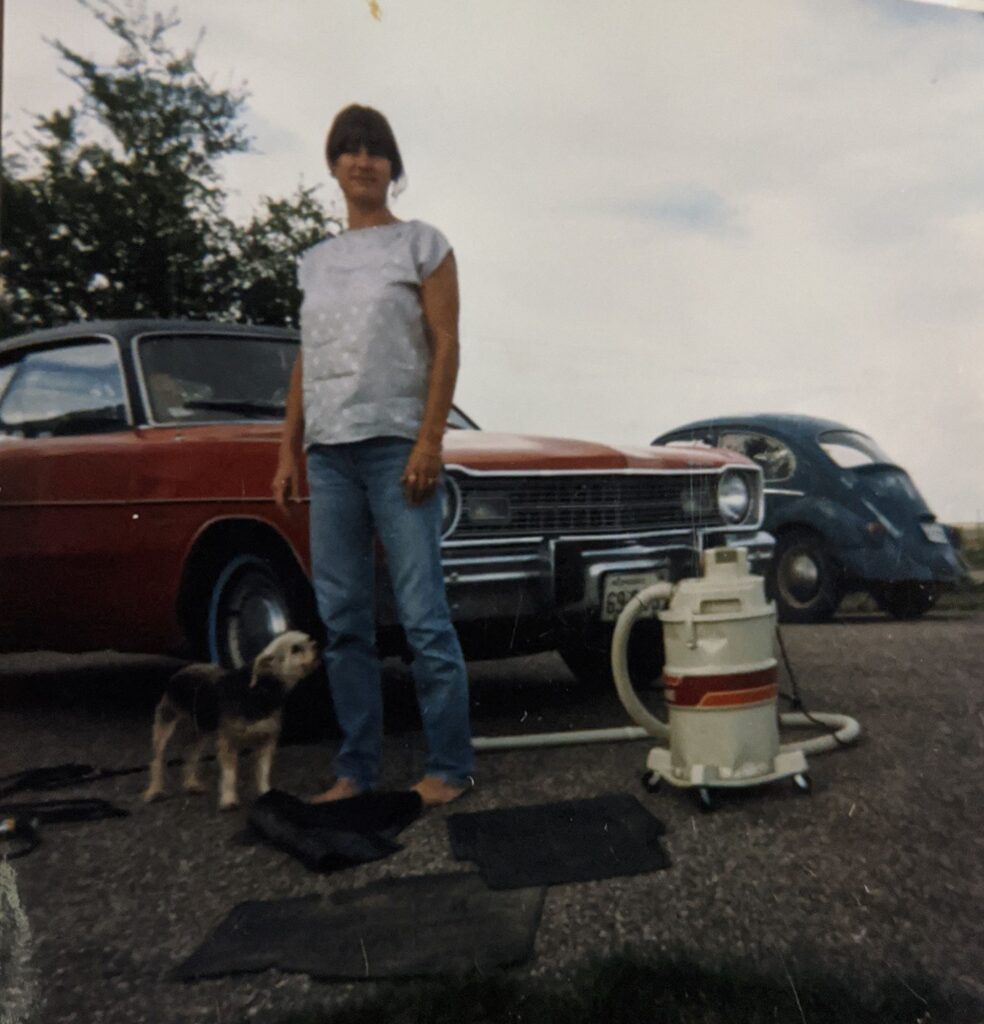
When I was a kid, I thought my Dad’s car was faster than my Mom’s car. When I asked my folks about it, I got unsatisfying answers about it probably just seeming faster because of the seating position or the noisy, rear mounted engine. I knew his car couldn’t actually be faster; it had a much smaller engine which produced much less horsepower and torque. What I didn’t realize as a kid was that Dad simply drove his car faster.
My Dad was what they call today a “spirited” driver and he piloted that old 40-horse Volkswagen with the same energy he’d have expected from a supercharged Chevelle. He stretched every gear change to the peak of the power output and upshifted so quickly little forward momentum could be lost. He knew exactly how much corner that little car could take and how to tap the throttle and sling it across the apex. The gravel back roads offered stimulating sine-wave hills to barrel up and down with a proud plume of white limestone dust in our wake. Unlike many men of his generation who considered economy cars dreary and emasculating, he seemed to consider his shabby old Volkswagen a personal challenge for envelope-pushing and drove that car up to the to the last gasp of its capacity.
Mom, on the other hand was a timid driver. She didn’t learn until she was 28 and realized that, what with Dad changing jobs at the time, she’d be left with two small kids and no way to get anywhere unless she learned to drive. She asked Dad to get her something “easy” and he turned up what was then a low-mileage, five years old Dodge at a steal of a price*. The Dodge Dart Sport looked like a muscle car, but hers came equipped with a slant-six engine and an automatic transmission. Built in 1974 at the vanguard of the fuel crisis, it was “long legged,” with a high final gear ratio for economical highway cruising. That car ran its best at about 65mph during the era of national 55. Mom had to monitor herself carefully as it took very little extra pedal to creep into the speeding ticket zone. According to my Dad, the Dodge was good for 90, if you needed it to be, which he judged necessary the day my Mom was bitten by a rattlesnake, but most of the time it never crested past 60.
Because of the difference between their driving styles, mundane trips with either parent had a different vibe. There was always just a hint of shenanigans in an outing with Dad. To be fair, Dad was more of a shenanigator than Mom in all areas of life and I think the two of them provided each other an excellent system of checks and balances.
One time Dad volunteered to drive on one of the school field trips. Not only did he end up mending another parent’s car on the side of the road, he also presided over a raucous burping contest among myself and the two boys in my class. They jumped at the almost unheard of opportunity to ride with a Dad on a field trip and strove to outdo themselves in stereotypical boyish hijinks, over which my Dad looked with considerable indulgence. He learned the finest of elementary school insults such as “butt head,” “butt face,” and more bizarrely, “toilet jaws.” It must have been a hell of an elucidating trip.
*the Dart came so cheaply, my parents later discovered, because it was what was known as a “clip car” which is to say that it was the average of two cars that had been wrecked ,(which fact was never disclosed). The back half of a car that had taken a header provided the passenger cabin and the front half of a car that had been rear-ended provided the bumper, grille, hood, fenders, engine, and presumably the transmission. The front metalwork was resprayed to match the back and there you go, good enough as new. Only it turned out that the front paint was a different formulation than the back, and when it started to oxidize, the front of the car would begin to turn orange while the back stayed red. To combat this aesthetic shortcoming, Mom waxed her car with clockwork regularity because she LOATHED the orange fade. The photo opening this story is during one of her Dodge detailing sessions.